
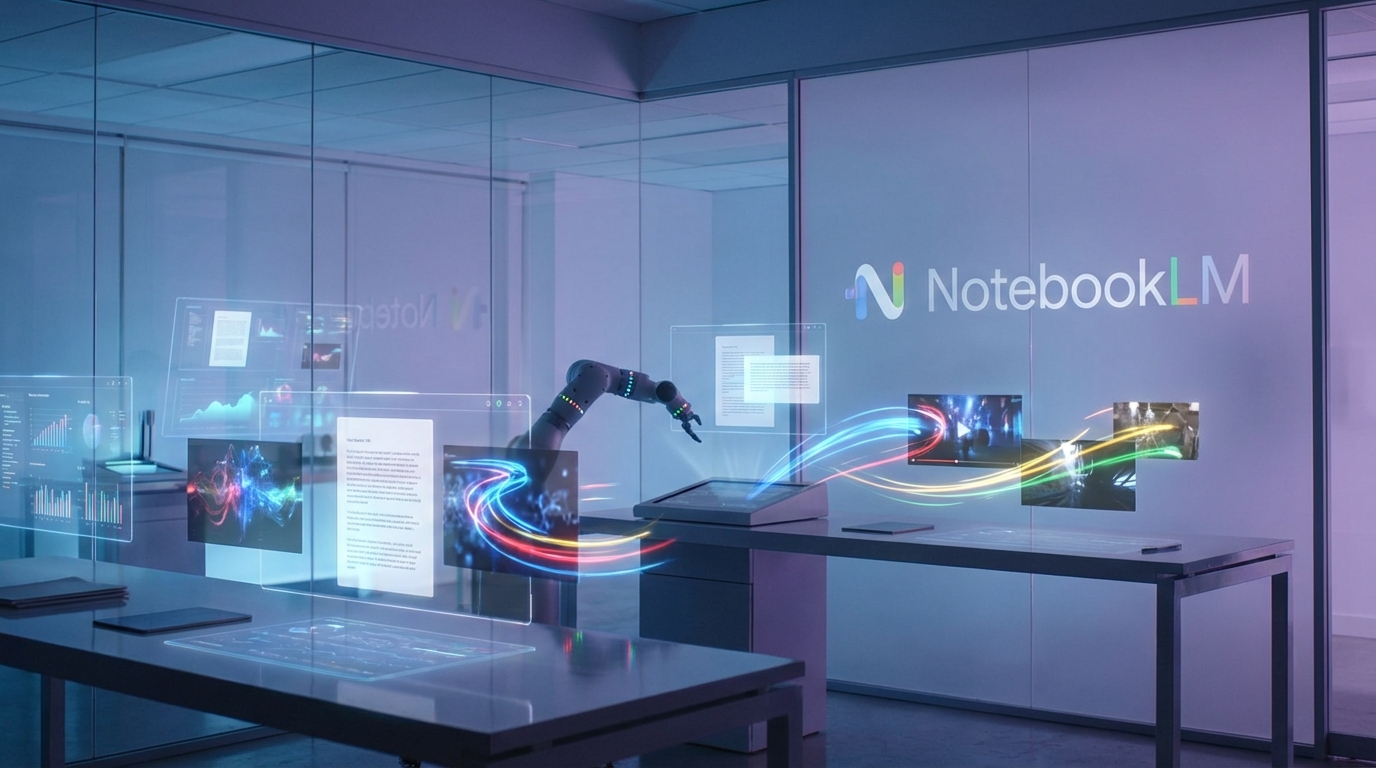
Google has just unveiled a significant upgrade to NotebookLM, its AI-powered research assistant. The new “Cinematic Video Overviews” feature transforms how users consume and share their research by generating fully animated, professionally styled videos from their notes and sources.
From Slideshows to Cinema
NotebookLM first introduced video overviews last year, allowing users to generate narrated slideshows from their research materials. While useful, these early videos were essentially static presentations with voiceover narration. The new cinematic feature represents a quantum leap forward.
The upgraded system now creates dynamic, animated videos that feel more like documentary content than academic presentations. Instead of simple slides, users get fluid animations, rich visuals, and sophisticated storytelling that brings their research to life.
The AI Orchestra Behind the Scenes
Google’s implementation leverages multiple cutting-edge AI models working in concert:
Gemini 3 acts as the creative director, making hundreds of structural and stylistic decisions. It analyzes your source material, determines the best narrative arc, selects appropriate visual styles, and even refines its own work to ensure consistency throughout the video.
Nano Banana Pro contributes to the processing pipeline, helping to understand and structure the content efficiently.
Veo 3, Google’s advanced video generation model, handles the actual animation and visual creation, producing smooth, professional-looking footage.
This multi-model approach allows NotebookLM to handle complex research topics while maintaining visual coherence and narrative flow. The system doesn’t just summarize—it interprets, structures, and presents information in the most engaging format possible.
How It Works
The process is remarkably straightforward for users:
- Upload your sources - Add research papers, articles, notes, or any documents to NotebookLM
- Request a video overview - Select the new cinematic video option
- Let AI work its magic - The system analyzes your content, creates a narrative structure, and generates animations
- Review and share - Get a polished, shareable video that summarizes your research
The AI handles everything from script writing to visual design, choosing appropriate animation styles, pacing, and visual metaphors that match your content’s tone and subject matter.
Who Gets Access?
Cinematic Video Overviews are rolling out today (March 4, 2026) to Google AI Ultra subscribers aged 18 and above. The feature is available in English on both web and mobile platforms.
This premium positioning makes sense given the computational resources required to generate these videos. Running multiple frontier AI models simultaneously—Gemini 3 for creative direction, Veo 3 for video generation—demands significant processing power.
The Bigger Picture: AI Video Evolution
This launch fits into Google’s broader push in AI-generated video content. Last month, the company upgraded Veo to version 3.1, adding new capabilities for vertical video formats and more granular control over visual elements.
The timing is strategic. As AI video generation becomes increasingly sophisticated, Google is positioning NotebookLM as more than just a research tool—it’s becoming a complete content creation platform. Students, researchers, educators, and professionals can now transform dense academic material into engaging video content suitable for presentations, social media, or educational purposes.
Practical Applications
The potential use cases are diverse:
For Students: Transform thesis research into presentation-ready videos for defenses or class projects.
For Educators: Create engaging video summaries of complex topics for online courses or flipped classrooms.
For Researchers: Generate accessible video abstracts of academic papers to increase reach and understanding.
For Professionals: Convert market research, competitive analysis, or project documentation into shareable video briefings.
For Content Creators: Repurpose written research into video content for YouTube, social media, or newsletters.
The ChatGPT to Notion Connection
For users managing their AI workflows, tools like ChatGPT to Notion become even more valuable in this new landscape. While NotebookLM excels at video generation, many users still prefer organizing their AI-generated content in Notion databases for long-term reference and collaboration.
The workflow could look like this: Use ChatGPT for initial research and ideation, save key insights to Notion via ChatGPT to Notion, then import those notes into NotebookLM for video generation. This creates a seamless pipeline from research to organization to presentation.
Technical Considerations
The multi-model approach raises interesting questions about AI video generation:
Quality vs. Speed: Generating cinematic videos requires significant processing time. Users should expect longer wait times compared to simple text summaries.
Consistency: Google emphasizes that Gemini “refines its own work to ensure consistency,” suggesting the system performs multiple passes to maintain visual and narrative coherence.
Customization: It’s unclear how much control users have over the final output. Can you specify visual styles, pacing, or narrative approaches? These details will likely emerge as users experiment with the feature.
Competitive Landscape
Google isn’t alone in the AI video space. OpenAI’s Sora has generated significant buzz, though it remains in limited release. Runway, Pika, and other startups are also pushing boundaries in AI video generation.
What sets NotebookLM apart is its integration with research workflows. Rather than generating videos from text prompts, it understands document structure, academic citations, and research narratives. This specialization could give Google a unique advantage in educational and professional markets.
Looking Ahead
The introduction of cinematic video overviews signals where AI research tools are heading: beyond text-based summaries toward multimodal content creation. As these systems improve, we might see:
- Real-time video generation during research sessions
- Interactive videos that adapt based on viewer questions
- Integration with presentation software for live demonstrations
- Collaborative video editing where multiple users contribute sources
For now, NotebookLM’s cinematic videos represent a significant step forward in making research more accessible and engaging. Whether you’re a student preparing a presentation, a researcher sharing findings, or a professional creating training materials, AI-generated video summaries are becoming an increasingly powerful tool in the modern knowledge worker’s arsenal.
The question isn’t whether AI will transform how we create and consume research content—it’s how quickly we’ll adapt to these new capabilities and what creative applications we’ll discover along the way.