
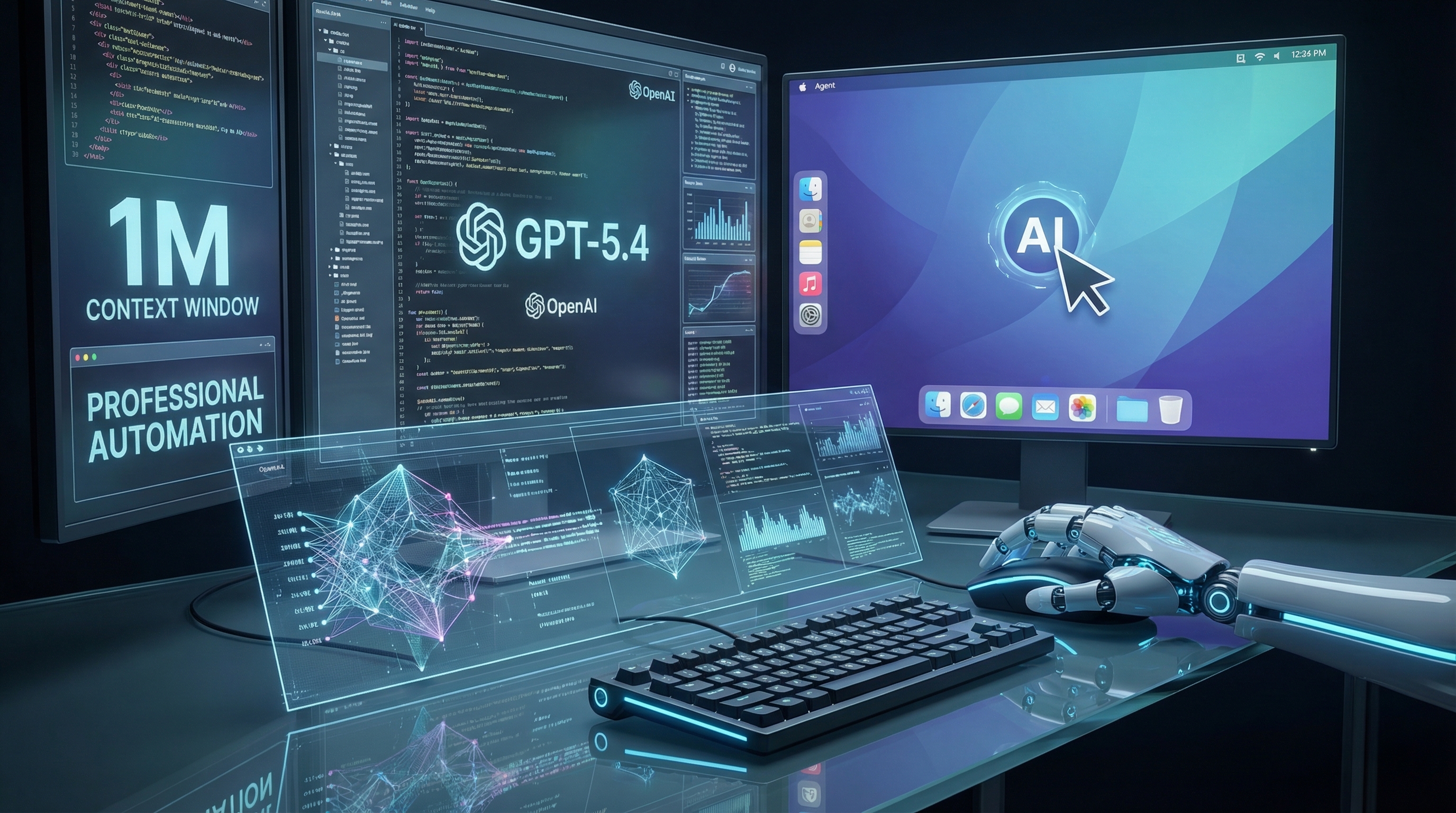
In the early hours of March 6, 2026, OpenAI quietly released GPT-5.4—and it might just be the most important AI model launch of the year for developers and AI agent builders.
Why? Because GPT-5.4 finally solves a problem that has plagued the AI agent ecosystem for months: finding a model that excels at coding, world knowledge, and affordability all at once.
The Agent Model Trilemma
To understand why GPT-5.4 matters, you need to understand what makes a great AI agent foundation model. According to experienced AI agent developers, an ideal agent model needs three things:
- Strong coding ability - The modern world runs on code; agent capabilities are fundamentally tied to code execution
- Broad world knowledge - Agents need to understand business context, communicate naturally, and reason about real-world scenarios
- Affordable pricing - Enterprise-scale agent deployments require cost-effective models
Until now, no single model delivered all three.
Claude Opus 4.6 was the gold standard for agents—excellent coding, strong world knowledge, and decent multimodal capabilities. But it’s expensive. API pricing at $5/$25 per million tokens (input/output) makes large-scale deployments prohibitively costly.
GPT-5.3-Codex had incredible coding abilities—it could execute tasks with surgical precision. But it was a specialized programming model with weak world knowledge, even worse than GPT-5.2. It spoke in technical jargon that non-programmers struggled to understand. Great for code execution, terrible for planning and communication.
GPT-5.2 had solid world knowledge and reasoning but lacked the coding prowess needed for complex agent tasks.
GPT-5.4 changes everything.
What Makes GPT-5.4 Special
GPT-5.4 is essentially:
GPT-5.3-Codex’s coding ability + Better-than-GPT-5.2 world knowledge + Enhanced tool use + Affordable Codex subscription pricing
Let’s break down the key improvements:
1. Coding Ability: Matches GPT-5.3-Codex
On SWE-Bench Pro (real-world software engineering tasks across four programming languages), GPT-5.4 scores 57.7%—essentially matching GPT-5.3-Codex’s 56.8%.
The coding excellence is preserved, but now it comes with something GPT-5.3-Codex desperately lacked: the ability to communicate like a human.
2. World Knowledge: Surpasses GPT-5.2
On GDPval (testing AI performance on real professional work across 44 occupations), GPT-5.4 achieves 83.0%—significantly better than GPT-5.3-Codex’s 70.9% and even Claude Opus 4.6’s 78.0%.
This means GPT-5.4 doesn’t just write code—it understands business context, legal concepts, financial modeling, and can communicate about these topics in natural language.
Early users report that GPT-5.4 finally “speaks human” instead of technical jargon. It can explain what it’s doing, why it’s doing it, and adjust its approach based on conversational feedback.
3. Computer Use: Best-in-Class
On OSWorld-Verified (testing AI’s ability to operate computers like humans), GPT-5.4 scores 75.0%—surpassing Claude Opus 4.6’s 72.7% and even exceeding human performance at 72.4%.
GPT-5.4 can:
- Click, type, and navigate between applications
- Understand screenshots and respond with appropriate actions
- Execute complex multi-step workflows across different software
- Operate at impressive speeds (see demo videos showing real-time computer control)
4. Tool Use: Dominates the Competition
On Toolathlon (measuring AI’s ability to use tools and APIs), GPT-5.4 scores 54.6%—nearly 10 percentage points ahead of Claude Sonnet 4.6’s 44.8%.
This is crucial for agent deployments, where models need to reliably call APIs, use external tools, and orchestrate complex workflows.
Key Technical Improvements
1M Context Window
GPT-5.4 supports up to 1 million tokens of context (experimental in Codex)—more than double GPT-5.3’s 400K limit.
For agents, this is transformative. Agents need to maintain context throughout long task executions. A larger context window means:
- Holding entire codebases in memory
- Maintaining task context across extended workflows
- Reducing context loss and “forgetting” issues
Note: OpenAI charges 2x for usage beyond 272K tokens, but given Codex’s generous subscription limits, this remains affordable for most use cases.
Native Computer Use Capabilities
GPT-5.4 is OpenAI’s first mainline model with native computer-use abilities built in from the ground up.
It excels at:
- Writing Playwright code to control browsers and applications
- Responding to screenshots with mouse and keyboard commands
- Combining code and vision for seamless computer control
OpenAI released a new skill called playwright-interactive that allows Codex to visually debug web and Electron apps—even testing apps as they’re being built.
Tool Search Optimization
Previously, when models were given tools, all tool definitions were included in the prompt upfront—adding thousands of tokens per request.
GPT-5.4 introduces tool search: the model receives a lightweight list of available tools and looks up specific definitions only when needed.
Result: 47% reduction in token usage while maintaining the same accuracy.
This is similar to progressive skill presentation—optimizing context management and reducing costs.
Pricing: The Affordability Advantage
Here’s where GPT-5.4 really shines for agent builders:
API Pricing (per million tokens):
- GPT-5.4: $2.50 input / $15 output
- Claude Opus 4.6: $5 input / $25 output
- GPT-5.4 is 50% cheaper than Claude Opus 4.6
But the real advantage is Codex subscription access:
- $20/month ChatGPT Plus gives generous Codex usage limits
- No need for expensive API keys for development and testing
- OpenAI explicitly supports third-party tools using Codex quotas
Compare this to Claude, where:
- Anthropic blocks third-party tool access to subscription quotas
- You must use expensive API keys for agent deployments
- Enterprise costs can quickly become prohibitive
Real-World Impact: Why This Matters for AI Agents
GPT-5.4 solves the fundamental trade-offs that have limited AI agent deployments:
Before GPT-5.4:
- Want great coding? Use GPT-5.3-Codex, but sacrifice communication and world knowledge
- Want great reasoning? Use Claude Opus 4.6, but pay premium API prices
- Want affordability? Use GPT-5.2, but accept weaker coding abilities
With GPT-5.4:
- Excellent coding (matches GPT-5.3-Codex)
- Superior world knowledge (beats GPT-5.2 and Claude Opus 4.6)
- Best-in-class computer use and tool use
- Affordable pricing with Codex subscription access
Early User Feedback
Developers testing GPT-5.4 in coding assistants like Cursor and similar tools report:
Communication Quality:
- Finally “speaks human” instead of technical jargon
- Can explain complex code changes in accessible language
- Better at understanding business requirements and translating them to code
Task Execution:
- Maintains context better across long coding sessions
- More reliable tool use and API calls
- Faster execution speeds with /fast mode (1.5x token velocity)
Frontend Development:
- Noticeable improvement in UI/UX aesthetics
- Better understanding of design principles
- More functional and polished outputs
Availability and Recommendations
ChatGPT:
- Available now to Plus, Team, and Pro users as GPT-5.4 Thinking
- Replaces GPT-5.2 Thinking (legacy access for 3 months)
Codex:
- Rolling out now with experimental 1M context support
- Supports Codex subscription quotas (no API key required)
API:
- Available as
gpt-5.4andgpt-5.4-pro - Pricing: $2.50/$15 per million tokens (50% cheaper than Claude Opus 4.6)
The Bottom Line
For AI agent builders, coding assistant users, and anyone deploying AI for real work, GPT-5.4 represents a watershed moment.
It’s the first model that doesn’t force you to choose between coding excellence, world knowledge, and affordability. You get all three.
If you’re using AI coding assistants or building AI agents, switch to GPT-5.4 as your default model. The combination of technical capability and cost-effectiveness makes it the obvious choice.
OpenAI has delivered what the agent ecosystem has been waiting for: a true foundation model that can code like GPT-5.3-Codex, reason like GPT-5.2, and won’t bankrupt your budget.
The era of practical, affordable AI agents has arrived.